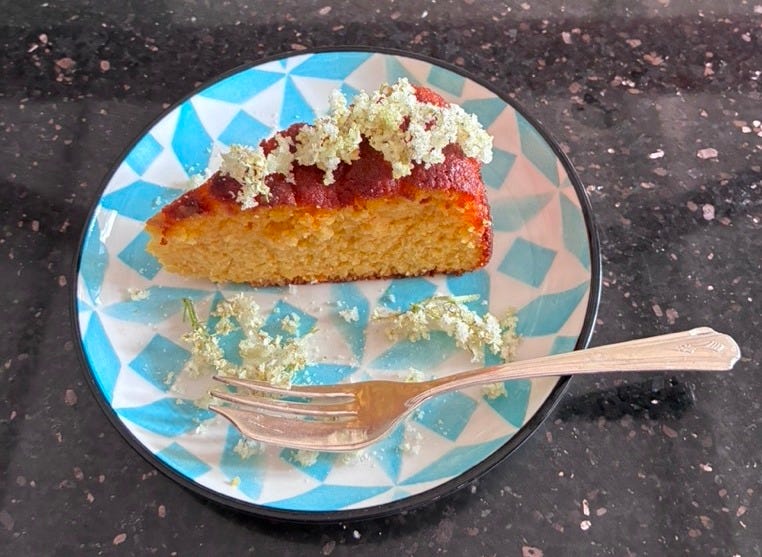
Elderflower power
With or without gardening - but definitely to enjoy IN the garden

I had a bit of a crisis with this post. Having spent far more time on it than I planned, I realised it wasn’t about gardening.
Most people gather elderflowers from hedgerows or parks. And, even if you do have an elder tree — Sambucus nigra — in your garden, you don’t have to garden it. It just grows.
But, I reasoned, clutching at straws, Gardening on the Brain is about finding joy and health in plants and nature. I reminded myself that I mustn’t discriminate against those without a specific plant in their gardens.
Besides, June is snowy with elderflower blossom. It floats like soft clouds, palm-sized umbrels turning from milk-white to lightly churned cream before producing tiny green-then-maroon berries which, come September, will be food for birds or for you to make a spectacularly dull juice (or wine, though I’ve never tasted an elderberry wine I’d want to make again).
However, I was still having a crisis. Was I going off-piste? What would become of me?
So, naturally, I applied super-cool analysis to the situation and realised:
The FIFTEEN things I was telling you to make were about thirteen too many.
You only need TWO, because the first is special and the second allows you to make everything else worth making (which is a lot).
Life is way too short to do fifteen things with elderflower.
Also, batter, which I will come to.
And I had a further brainwave:
This IS about your garden, because…
…you’re going to consume the results while sitting IN your garden. Job done.
Imagine: you can sit in your garden under a tree shading you from the intense June heat (I’m dreaming) and you can read about my batter trauma.
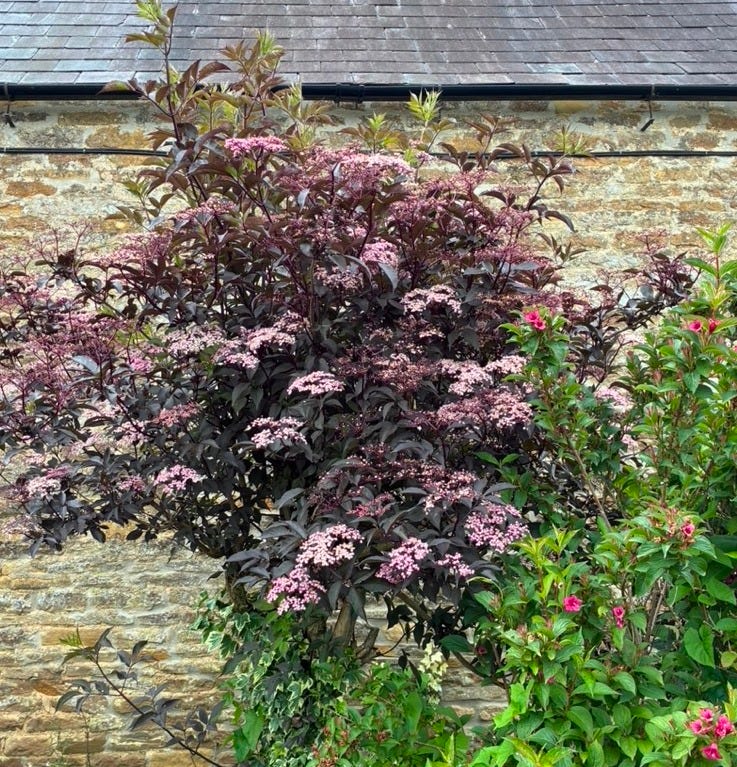
Also, if you want pink elderflower, you need a different sort of tree from the one you’ll find in hedgerows. I do have one in my garden, because I am wise. Here she is today:
So, buy a black elder
‘Black’ elder is the one with pink blossom and shiraz-coloured leaves which Homer indubitably had in mind when he kept describing the sea as oinops, which is variously but not quite adequately translated as ‘wine-dark’, ‘wine-looking’, wine-like, or ‘wine-eyed’. None of these help us imagine the Mediterranean — unless seen through wine-sozzled eyes — but they neatly describe black elder leaves.
Why grow it? Because it’s incredibly pretty and you won’t find it growing wild. It tastes identical but everything you make with it is pink.
Get one now so that next year you can make the pink version of elderflower ‘champagne’, plus the other things I’ll be describing.
Hang on, Nicola. Did you say sambuca back there?
I said Sambucus, to be fair. Yes, there is a connection with Sambuca. But don’t get excited: it’s an unsatisfactory connection.
Sambuca is an Italian liqueur flavoured with anise but is named after its predecessor, a quite different liqueur which was made from elderberries. Not flowers. Clearly, they just liked the name.
I told you it was unsatisfactory.
Talking of unsatisfactory, batter
If you are unlucky, you have seen recipes online for elderflower fritters. Do not countenance making this travesty.
Batter is the incarnation of evil. It has a tendency to make a piece of fish difficult to find and, since I love fish, I see no point in hiding it in grease and making it taste of bad pub kitchens and a smoking chef.
Moreover, as a child I was traumatised by spam fritters. I was unable to swallow them without gagging and at my boarding school I became adept at cutting them up and flicking them onto the floor or my lap while distracting the teacher with some earnest and unlikely question about Latin or Greek.
I do not use the word ‘traumatised’ lightly but, really, the unsuccessful therapy has been long and involved expensive restaurants. Even those can’t seem to make a batter worth swallowing. I recently made the mistake of not noticing the word ‘tempura’ in the description of a courgette tapa. Each mouthful was oil and the poor courgette was mush beneath the weighted blanket of batter.
But the internet occasionally mentions elderflower fritters and I wondered whether, if the batter were to behave like a bride’s veil, the marriage might work. Floral crunchiness. Crispy snackery with added sweetness.
I almost came to believe, through the deviousness of AI-generated nonsense on Instagram, that it might be delicious and that we might have it as a canapé during our June feast in a couple of weeks. So I was going to test it. For you.
Then, I came to my senses. Honestly, I am not going to wreck a perfectly decent offering of nature by slathering it in batter and frying it until it is weeping grease straight into my arteries.
My body is a temple and, no, even you are not worth it.
Elderflower ‘champagne’, on the other hand
Is one of my favourite things in the world.
‘Champagne’ in inverted commas because obviously it is not champagne. But if I say ‘fizz’, you will think I mean elderflower cordial with the addition of carbonated water. I DO NOT MEAN THIS. Elderflower champagne, with or without punctuation, is a proper, grown-up drink of extreme specialness and you cannot (to my knowledge) buy it.
My parents made this so I’ve been drinking it since childhood. I have belatedly discovered that it is likely to be somewhat alcoholic. This explains a lot. Additionally, it becomes more alcoholic the older it gets and, since my parents used to keep it until it exploded in the cupboard and they generally took no notice of sell-by dates in any case, this explains even more. (My mother may be reading this, so I would like to confirm that no one ever became ill from eating or drinking anything from her excellent kitchen.)
Anyway, any damage from early exposure is done and this is the one thing I will continue to make every year until I am carried away, pickled by a happy life.
Last year, it was my Ruby Wedding Anniversary and I made the pink variety for the first time, which I am definitely repeating for as long as have two legs to stand on.
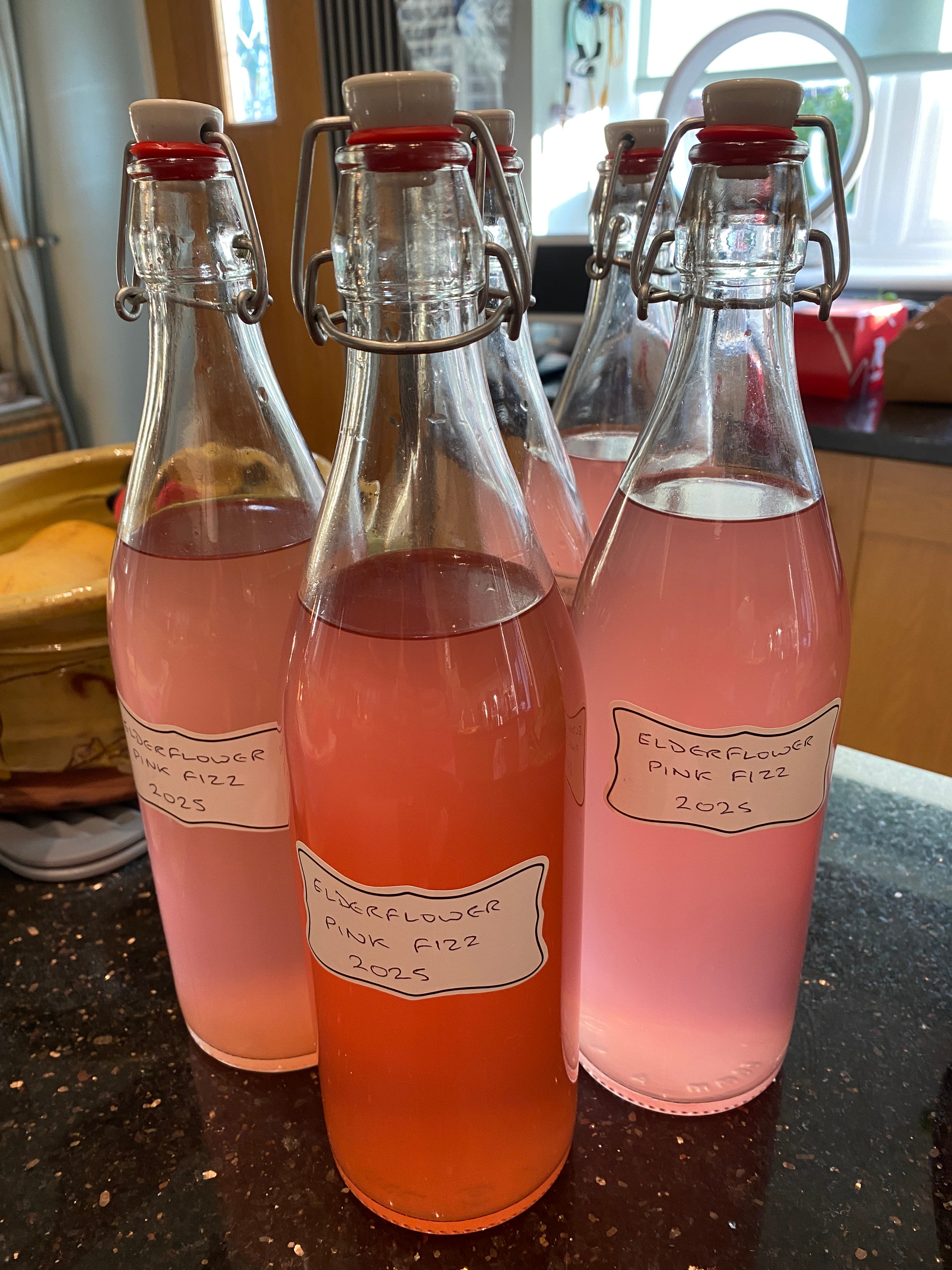
Also belatedly, I have discovered that, despite being alcoholic (the drink), it is genuinely good for you, because fermented, which is kind of obvious once you think about it. And fermented things get up to all sorts of jollity in our gut microbiome.
Elderflowers are special in two ways
The flavour/scent intensifies
Most flower scent fades during the process of turning it into food. Elderflower scent is underwhelming and vague on the tree but intensifies when magicked in the kitchen. It’s as though it didn’t know what it was for until it was told.
The taste is much better than the scent
Most edible flowers smell better than they taste. Lilac smells heavenly but the taste has an edge which needs careful softening. Calendula looks amazing and has healing properties but no notable smell or taste. Elderflower smells vaguely and unpromisingly of outdoors but tastes extraordinary in sweet and savoury dishes and drinks.
And you cannot buy fresh elderflowers.
‘What about cordial, Nicola? I can buy that all year. Why go to the trouble of making it?’
Yes, so I’m not going to the trouble of telling you how to make cordial. It is not a replacement for syrup. Syrup is not cordial.
A quick warning
Some parts of the tree are toxic. Stems, leaves and raw berries should not be eaten. Only eat the berries when cooked and don’t eat the leaves or stems at all. (Tiny bits of stem are fine.) The flowers are safe, though, especially processed in any of the ways below.
For more details on safety, see here.
What we will make
Compulsory for all sensible people:
Elderflower ‘champagne’ — white or pink. Properly fermented and naturally sparkling (sometimes very…).
Elderflower syrup — not cordial… — and I will show you how with this one thing you can make many different desserts.
Important if you want to elevate your cooking (and drinking)
Elderflower shrub — the base for drinks and salad dressings
Optional but useful:
Elderade — refreshing summer drink invented by me
Crystallised elderflowers — delicious and stunning decorations (for desserts, not rooms)
Dried elderflowers — to make ‘tea’ later in the year
Elderflower sugar — to use if you run out of syrup, as you might, because I will show you endless uses.
The recipes
If you haven’t taken out a paid subscription, now is the time. Otherwise, do come back next week for the next free post from Gardening on the Brain. You’ll be just as welcome, but less full of the power of elderflower champagne.
And cake.